


Hello to my regular readers and to my #AuthorToolbox friends! The Internet is brimming with articles on how to write a query, but in my year of critiquing them, I’ve noticed something: many authors know what to include, but are lost as to how to include it. I figured I’d start out with an article on how to structure a query, and go into more detail later. If you like what you see, I do offer query critiques at $5 per pass!

The 2 Query Bodies
The purpose of a query is simple: it must have a SUMMARY and a CATEGORIZATION of the book. Every fiction query requires both of these “bodies,” and each of these bodies must include the following elements (I put them, more or less, in the order that they should appear):
Body #1 – The Summary
- Setting
- Main Character
- Story Arc
- Conflict
- Character Arc
- Stakes
Body #2 – The Categorization
- Title
- Age Category
- Genre/Subgenre
- Word Count
- Comparative Titles*
- Standalone/Series
- Author Accolades (if any)
- Author Bio
- Thanks to the Agent
- Optional Items:
- Agent Personalization
- Hook(s)
- Complete/Incomplete
- Debut/Non-Debut
*Some authors choose to leave out comparative titles, but from my experience, this is ill-advised.
The 2 Query Structures
Query structure determines how you break up your query bodies and the number of paragraphs you use to do so (paragraph count is where first-time authors often go awry). There are more ways to structure a query than just the SANDWICH and the DIVE, but these are the most common (and successful) constructions I come across. Of the two, I have used and loved the SANDWICH, but from my experience, agents differ randomly on which they prefer. However, please note that I’ve never met an agent who will reject based on an author not using their preferred structure, so don’t stress too much over your choice.
 Structure #1 – The Dive
This structure is the simplest (and most blunt) option. Open by leaping directly into your SUMMARY, and follow with your CATEGORIZATION. However, if you have met your agent in person or had a personal request from them, always have this in your opening line (and likely in its own paragraph).
Paragraph 1-2
- SUMMARY
Final Paragraph
- CATEGORIZATION
Structure #2 – The Sandwich

This structure opens with the key items of your CATEGORIZATION, which will allow the agent to easily determine if they are currently accepting what you are offering. It then jumps into the SUMMARY, and saves the less essential CATEGORIZATION elements for last. Always put your agent personalization in your opening line, should you include it.
Paragraph 1
- Agent Personalization (optional)
- Title
- Age Category
- Genre/Subgenre
- Complete/Incomplete (optional)
- Word Count
- Hook (optional)
Paragraphs 2-3
- SUMMARY
Final Paragraph
- Comparative Titles
- Standalone/Series
- Author Accolades (if any)
- Author Bio
- Debut/Non-Debut (optional)
- Hook* (optional)
- Thanks to the Agent
*You can have two Hooks if you like, as Hooks tend to be a bit nebulous, describing anything from main conflict to theme to subgenre elements to awards the draft has earned. As long as they are brief, you can have several.
Side Notes
- Many of the query body elements can be interwoven into the same sentence.
- The Thanks to the Agent can be on its own line, prior to your signature.
- Author Accolades can be both writing-related achievements or any experience relevant to the content of the book (e.g. a doctor writing about a doctor).
- If you have no Author Accolades, don’t worry! Just write a cool one-sentence Bio that lends to your personality. Conversely, if you have a lot of Author Accolades, you can skip the Bio sentence entirely.
- If you have met the agent or had a request from them, always, ALWAYS have this in your opening line! (This should be in its own paragraph if you are using the DIVE structure.)
- Some authors like to write what they’ve included in the query (page count, synopses, etc.) per the agent’s guidelines. I think this is a waste of your time. The agent will be able to tell if you’ve done this by reading your submission anyway, so spend your time personalizing based on what the agent is looking for instead.
Example of a SANDWICH Query
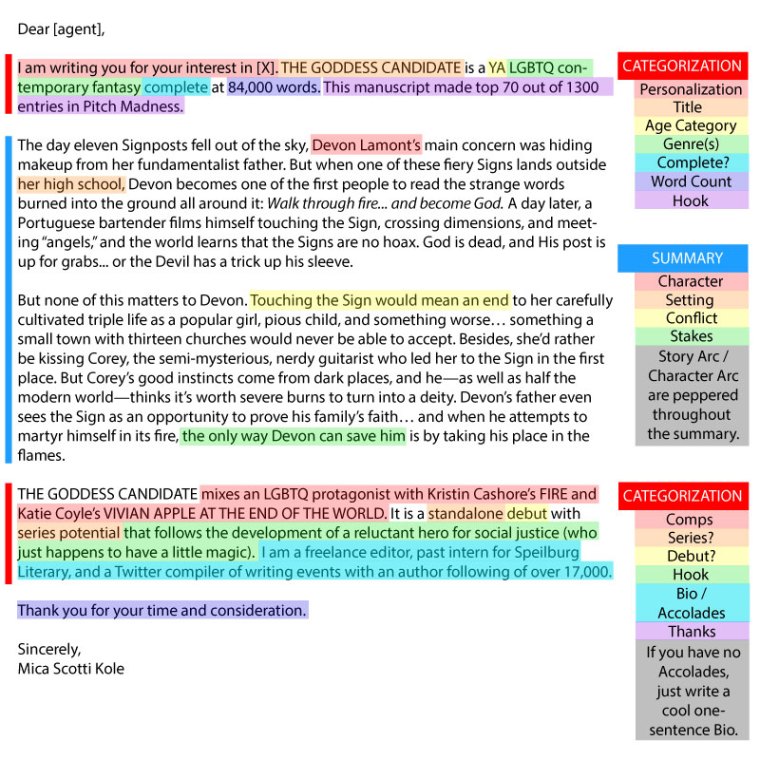
Below is the query that I had some success with in 2017 (“success” meaning more than five full manuscript requests and several partials, but sadly no agent offers). It is a SANDWICH query that I’ve highlighted to illuminate the different elements of my query bodies. I’ve tweaked it a little to better illustrate the structure.
If I was an agent, I’d sign your book. It’s really daring, and I love it. It’s going to happen. Great post by the way. I’ll add it on Facebook in a couple of weeks. 🙂
The book has had quite a lot of interest, but sadly the manuscript isn’t measuring up to the query/first pages. At least I’m doing good in the idea department! I’ll only get better with time, so it’s all uphill from here. And I’m so glad you liked my post, thank you!
Query letters are difficult, and I always like to come across advice that breaks them down like this. It’s so hard to say all you need to say in such a short time and make it interesting.
That being said, your pitch sounds REALLY interesting! Good luck with it!
This is a fantastic post. I linked to it from my website
Awesome, thank you! I’m so glad that you liked it, and thanks for the boost!
A very interesting and informative post, Mica. Thanks so much for sharing it. All best to you in 2018.
http://victoriamarielees.blogspot.com
Wow, this looks complicated but very useful. I’ve pinned to the Pinterest group and will export to PDF for future use. Thanks for such a thorough post and good luck with your query.
I know what you mean about complicated! Last time I wrote about how to write a query, it was six posts long, lol. I’m glad you found it helpful regardless, and thank you for sharing it with others!
Great post! I’ve seen a lot of info about how to write a query letter, but I like the way you’ve broken into down into pieces. Very helpful! Thanks for sharing 🙂
I’m glad it helped. There are a million posts on how to query; I just figured I’d throw my hat in the ring. Hopefully this particular breakdown will resonate with just one person it can help 🙂
I really appreciate how different this is from a lot of other articles about query letters. Definitely storing this one away just in case I ever decide to get back into the query game.
Wow, that’s a major compliment for me, thank you! I wrote this based on what I noticed from my clients’ critiques, so I’m glad to hear that translated well.
You put a lot of thought into this post. I’ve always considered the query a business letter and wrote as such. I included the same list you have, but inserted a in-regards line for: title, genre, word count, etc. Since reading Janet Reid’s blog, I’ve updated my style.
She claims too many writers don’t include what the story is about–goal, what’s stopping them and why should we care–when submitting. Structure is not the only thing to concentrate on. 🙂
Anna from elements of emaginette
Oh yes, I know there’s more to a query than structure, but this particular post was about structure. I just found with my clients that a lot of them have all the right ingredients but aren’t sure where to put them. And I consider the “hook” the place where you can tell what the story is about and/or hint at theme (if I’d gone into that here, it would have taken several more paragraphs… perhaps another post). Thanks for reading!
This post is incredibly helpful, Mica! I hope to start querying by the end of this year. I may take you up on your critique when the time comes.
I like how you offer options for putting it together (complete with the how and an example). How do you figure out comparative books? I’m terrible at comparisons…
Thank you! Comps can really be tough. Here are some options:
-Ask your beta readers what they’re reminded of.
-Search related titles on Amazon, and check “People who bought this also bought…”
-Read books with similar premises to see if they relate.
-Compare things other than content, like tone/structure/setting/MC.
-Compare other media, like TV shows/movies/anime.
Thanks so much for breaking down the structure of a query letter. I have plans to foray into reading up on them this year, and you gave me the perfect early start. Your book sounds really interesting. I know you can whip it into shape (uphill battle or no.) Best of luck! You can do this!
I’m glad to hear it was helpful! However, I’m told the post is a little complicated, and frankly it probably is. So I’d suggest circling back to this (or just keeping it in mind) after reading query-writing posts for beginners. It can be a harrowing process so don’t let me complicate it for you!
Great post.
Your book sounds so interesting! Fingers crossed an agent makes an offer soon 🙂
I’m glad I’m still leaning towards self publishing, as I have no idea how to categorise my latest work in progress, in age category or genre!
Ask your beta readers what they think about your genre/category. Even when self-publishing, you’ll want to pin down a genre, even if it’s nebulous, for the sake of categorizing it on Amazon and so on. And thanks for the comments on my book. Fingers crossed!
That’s a good idea, and a good point, thanks for the tip 🙂
And you’re welcome!
This is such amazing advice. Thank you so much for breaking the query letter down into easier to process parts!!
My pleasure! It’s a side of the QL I don’t usually see others posting about, so I figured I should share 🙂
Thank you for sharing. Many posts and events focus on the craft of writing, but few offer such concrete insights into the business and application side of things.
Thank you for saying so! I enjoy working with queries so much that this post was a no-brainer for me 🙂
Pingback: Author Toolbox Blog Hop: A Year in Review – E.M.A. Timar