

In light of the time of year, I’ve decided to take a break from my WIP and devote my time to a new #NaNoWriMo project. But where to start? I’ve always been a “pantser” and after editing my WIP into the ground, I’ve come to the conclusion that writing off-the-cuff results in too much time spent fixing plot. So this month, I’m going to be using several resources to get going:
The NaNoWriMo Website
 What a cool resource! You can put in your upcoming book’s information (it really pumps me up!), connect with accountability buddies who’ll also be participating (yay, more people to disappoint! *weeps quietly to self*), and get badges (I made a profile!). You can keep track of (and display) your word count during the month of November, and upload a summary, excerpt, and cover art for your book. And if you want a novel cover, but you’re useless with that stuff, hit me up and I’ll scrabble something together! No one should go without at LEAST a free image and a title in a fun font. You can connect with me on the site under the username Fieronis as well.
Joseph Campbell’s Hero’s Journey
My significant other is a high school English teacher, and he loves to teach this. It’s a general outline for all of the world’s most famous stories, most of which follow this guide without missing more than a handful of the 17 “steps.” These include meeting a “mentor” character and being thrust from one’s “ordinary world” into a “special world.” This video gives a basic rundown of the Journey, simplifying it to around 10 steps. YOU ABSOLUTELY MUST WATCH IT. It’s short and so fun!

Three-Act Story Structure
This is very similar to the Hero’s Journey, except that it gives you a stronger idea of how long and how far into the story different plot points ought to be. Because it’s geared more toward screenplays, the numbers you see on the Beat Sheet below pertain to movie minute counts rather than page counts, but you’ll get the idea (e.g. the background for your story should only take the equivalent of the first ten minutes of a movie, which is about 10% of your word count). This screenplay-style structuring will work fine for a book. Check out this YouTube video on the three-act structure for a more in-depth idea of what this is. It’s nice to see the comparisons to movies to get good mental images of what different story steps look like.


Michael Hauge’s Six Stage Plot Structure
This one is cool because it give you insight into the emotional arcs of your character. You can use this to plot out the actual events of the story as well as your protagonist’s “inner journey.” Since emotional journeys are not very tangible, they are (in my opinion) harder to fix than plot. It’s easier, or at least more formulaic, to rearrange a few scenes than to re-plot a character’s mental arc. For that reason, I am going to integrate Hauge’s Inner and Outer Journey structure with my use of the other plotting structures.

This Weirdly Specific Outline
I recently came across this and personally I look forward to playing with it. Seriously, check out that link and look at this thing. You almost don’t even need to plan a book. It’s incredibly specific. This is how it starts:
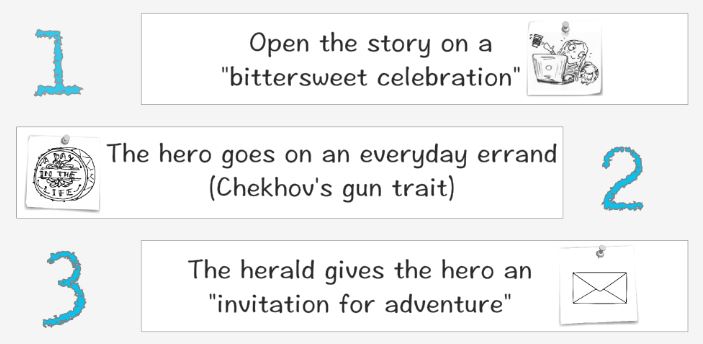
I’m hoping that these resources will mesh well with my organizational and creative brain. At the least, writing a blog about them has helped me understand how it works a little better!
Want more ways to spice up your writing? Visit Mica’s Free Online Writing Events Calendar for chances to get free professional feedback or to win contests, or read more of Mica’s Writing Tips posts!
What is a “panster”?
A pantser is someone who dives into a new writing project without anything to guide them – no outline, no character sheets, just an idea!
A great post, my dear! Very informative! I didn’t realize that you were also participating in NaNo this year! Personally, I can’t wait!
Sorry for my slow response. This was my first NaNo and I enjoyed it so much! Going to have to make it a tradition!